

When Your Shoulders Finally Remember What Lightness Feels Like
Roots & Reflections Saturday Edition

I’ve been thinking about this week’s theme more than I expected.
When I started writing on Monday, I thought we were going to spend the week talking about responsibility, pressure and exhaustion. They felt like obvious places to begin. Yet every article seemed to pull me somewhere else. By the middle of the week I realised I had stopped writing about what we carry and started writing about what carrying does to us.
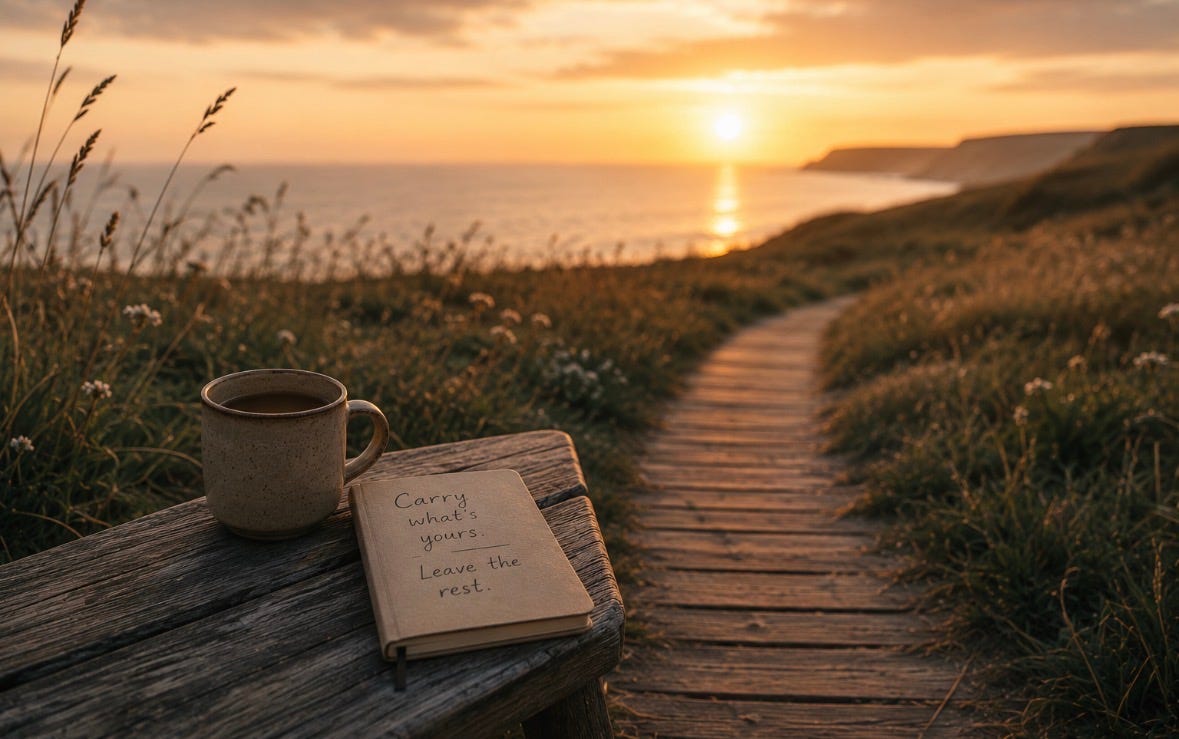
That feels like a very different conversation.
I keep coming back to one question.
What happens when you’ve carried something for so long that it begins to feel like part of who you are?
I think our bodies remember far more than we give them credit for. They remember seasons of life we’ve almost forgotten. They remember the people who made us feel safe and the ones who did not. They remember years spent waiting for the next problem, scanning every room, trying to stay one step ahead of disappointment.
Sometimes they even remember burdens that no longer exist.
That thought has stayed with me because I wonder how many of us are still walking through life as though we’re carrying a weight we’ve already put down.
Human beings are remarkably adaptable. We survive things we never imagined we could survive and, little by little, survival becomes familiar. We adjust without noticing. We become accustomed to tension. We stop questioning the pressure because it has been with us for so long that it feels ordinary.
The shoulders lift.
The jaw tightens.
Breathing becomes a little shallower.
The mind keeps scanning, even on peaceful days.
None of it feels unusual because it has become our normal.
I was thinking about someone finishing a long hike. They reach the end of the trail, take their backpack off and stand there for a moment. Their body still leans forwards because it has not quite realised the weight has gone. The muscles are responding to a burden that is no longer there.
I wonder whether we do something similar emotionally.
How many conversations do we enter expecting to manage somebody else’s feelings before they’ve even spoken?
How many mornings begin with our minds already solving problems that have not happened?
How many relationships are shaped by responsibilities that quietly became ours without anyone ever asking whether they should?
Sometimes the weight disappears before the posture changes.
That feels important.
We often expect insight to transform us overnight. We understand a pattern, recognise where it came from and hope everything else will quickly fall into place. Then we become frustrated when our bodies continue reacting in familiar ways.
Looking back, I think I have been unfair to myself more than once.
Understanding arrives quickly.
Trust usually takes longer.
The nervous system has no interest in beautiful ideas. It pays attention to repeated experience. Every boundary you keep, every moment of genuine rest, every time you allow somebody else to carry what belongs to them, another quiet message reaches your body.
You are safe enough now.
You do not have to hold everything together.
I like that thought because it feels patient.
It allows change to unfold at its own pace instead of demanding it happen immediately. There is kindness in recognising that your body has been trying to protect you all along. It may simply need time to realise the danger has passed.
As I’ve reflected this week, I have noticed how often we celebrate people for carrying more than anyone else. We admire endurance. We admire sacrifice. We admire the person who somehow keeps everything moving.
Very few people stop to ask how heavy their life has become.
Perhaps wisdom begins with that question.
Perhaps the strongest people are not those who can carry the greatest weight. Perhaps they are the ones who have learned what belongs on their shoulders and what never did.
That changes the journey completely.
You still care.
You still love deeply.
You still show up.
You simply stop measuring your worth by everything you can carry.
As you move into the week ahead, I hope you notice your shoulders from time to time. Not to judge them or force them to relax. Just to become curious. They have carried you through every chapter of your life. They have done exactly what they believed they needed to do.
Maybe this is the season where they learn something new.
Maybe they discover that love does not always have to feel heavy.
Maybe they discover that peace has its own posture.
Maybe they remember what lightness feels like.
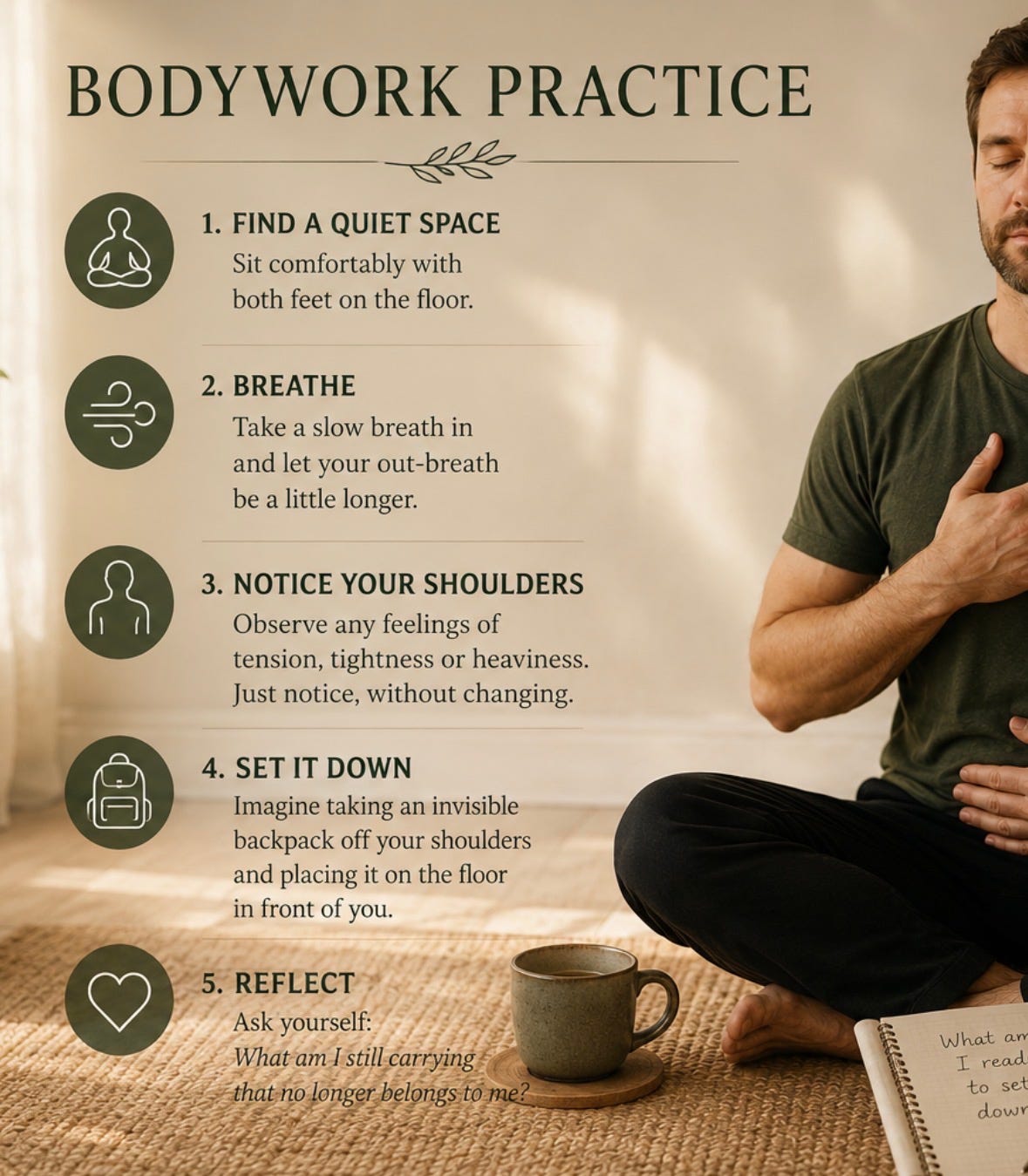
Body Work Practice
Find somewhere comfortable to sit with both feet resting on the floor.
Take a slow breath in through your nose and allow the out-breath to be a little longer than the in-breath. There is nothing to change yet. Simply notice how your body feels today.
Bring your attention to your shoulders. Notice whether they feel lifted, tense or heavy. Then imagine taking an invisible backpack from your shoulders and placing it gently on the floor in front of you.
Ask yourself:
What am I still carrying that no longer belongs to me?
Do not search for an answer. Let it arrive in its own time.
Stay with your breathing for a few minutes and notice whether anything in your body begins to soften.
Journal Reflections
What weight have I mistaken for part of my personality?
When did responsibility begin to feel safer than rest?
What am I still carrying for somebody else?
Where do I notice emotional weight in my body?
What would become possible if I trusted myself to carry less?
Complete this sentence without stopping to edit it:
If my shoulders could speak, they would tell me…
If this week’s reflections resonated with you, I hope they leave you with one quiet question.
Before you try becoming stronger, ask yourself whether the next chapter of your life is inviting you to become lighter.
This stayed with me from beginning to end. “Sometimes the weight disappears before the posture changes” is such a profound insight. We often expect understanding to transform us immediately, yet our bodies and hearts need time to trust what our minds already know. I also loved the closing thought that peace has its own posture. Quiet, compassionate, and deeply human. Thank you for sharing this beautiful reflection.